


IRC Roof Ventilation Code: NFA, Baffle Requirements, and Powered Fan Mistakes
May 28, 2025 by Rich White
IRC roof ventilation requirements aren’t just about adding vents—they’re a critical system to prevent moisture, heat damage, and premature roof failure.
This guide breaks down everything inspectors, contractors, and serious DIYers need to know about the 2021 IRC ventilation requirements (R806), what manufacturers expect, how to calculate Net Free Area (NFA), and what goes wrong when powered fans are added to passive vent systems.
Understanding IRC Roof Ventilation Requirements
R806.1 — Ventilation Required
All enclosed attics and enclosed rafter spaces must have cross ventilation unless you’re building an unvented attic with a conditioned roof deck under R806.5.
These IRC roof ventilation requirements are designed to ensure that every attic space receives the cross-ventilation needed.
R806.2 — Minimum Net Free Vent Area (NFA)
You have two compliance paths:
Standard Rule (1:150)
Provide 1 square foot of NFA for every 150 square feet of attic floor area.
Exception Rule (1:300)
You can reduce total venting to 1 square foot per 300 square feet if:
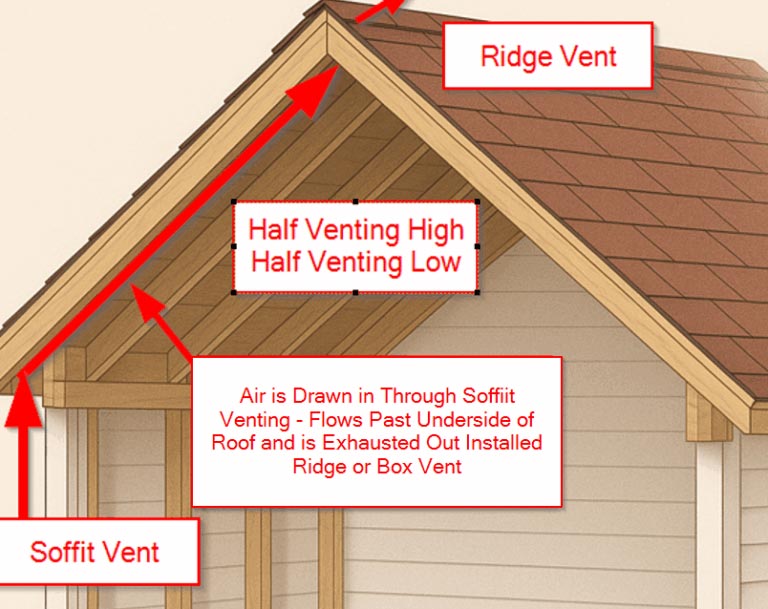
- 40% to 50% of ventilation is located at or near the ridge (high)
- The rest is at the eaves or soffits (low)
- And one of the following applies:
A ceiling vapor retarder (Class I or II) is installed on the warm-in-winter side of the insulation
Or the structure naturally allows air to move freely between upper and lower vents
What Is a Ceiling Vapor Retarder?
IRC recognizes two types:
- Class I: Poly sheeting, foil-faced drywall
- Class II: Kraft-faced insulation, certain vapor-retardant paints
- Must be installed below ceiling insulation to qualify
Without it, you must follow the 1:150 rule.
R806.3 — Vent Installation Guidelines
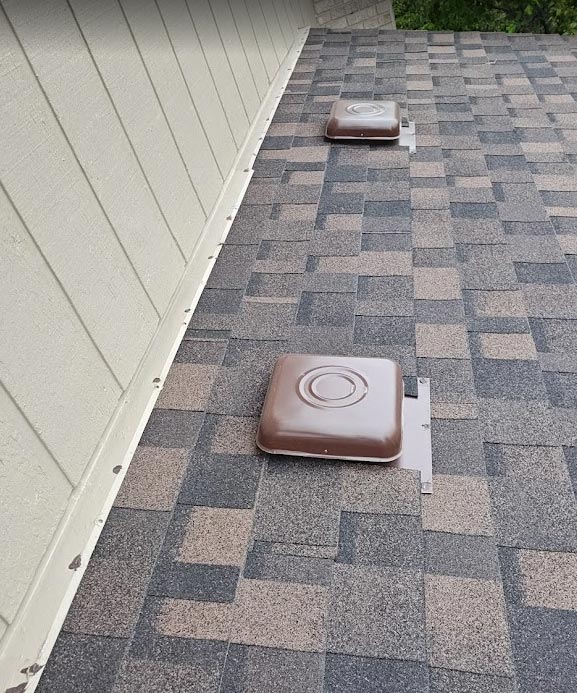
- All vents must resist rain, snow, and pest intrusion
- Soffit vents must not be blocked by insulation
- Baffles (air chutes) must be installed to ensure airflow between intake vents and the attic space
Baffle Vent Requirements (Airflow Chutes)
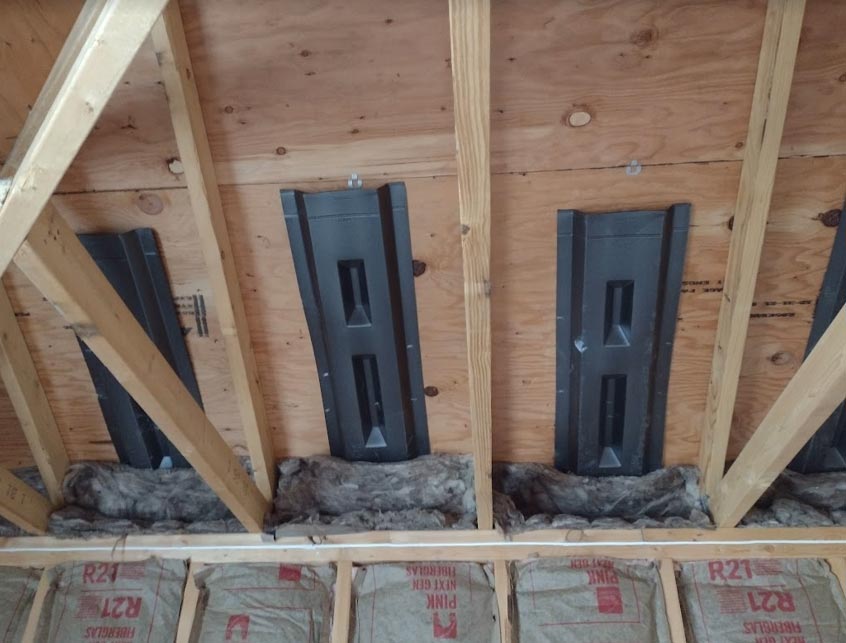
Proper installation of baffles is a key part of meeting IRC roof ventilation requirements, especially where soffit intake is required to meet 1:300 ratios.
One of the most overlooked causes of ventilation failure is insulation blocking soffit vents. That’s why IRC R806.3 requires baffles in every rafter bay where soffit vents are installed.
Code Summary:
- Baffles must provide at least 1 inch of clear airspace between the roof sheathing and insulation
- They must extend from the exterior top plate upward, usually 6 to 12 inches above the insulation line
- In cathedral ceilings, they must run continuously from soffit to ridge if vents are installed
Field Note: A well-vented soffit means nothing if the insulation blocks the airflow. No baffles = failed inspection.
Manufacturer Requirements (GAF, Owens Corning, CertainTeed)
Shingle manufacturers often hold installers to a higher standard than the IRC.
They typically require:
- A minimum 1:300 ventilation ratio
- Balanced intake and exhaust airflow
- No mixing of powered exhaust fans with passive ridge or slant-back vents
- Use of compatible, manufacturer-listed components for warranty compliance
Warranty red flag: Combining powered attic fans with ridge vents almost always voids coverage. These systems work against each other.
Ventilation Calculation Example
Attic floor area: 1,200 sq. ft.
Using 1:300 ratio (with ceiling vapor retarder)
- 1,200 ÷ 300 = 4 sq. ft. of total NFA
- 4 × 144 = 576 sq. in. NFA
- Split evenly: 288 sq. in. intake / 288 sq. in. exhaust
Option 1 — Ridge + Soffit Vents
- Soffit vents: 24 sq. in. each → 288 ÷ 24 = 12 vents
- Ridge vent: 18 sq. in./ft → 288 ÷ 18 = 16 linear ft
Option 2 — Slant-Back + Soffit Vents
- Slant-back vents: 60 sq. in. each → 288 ÷ 60 = 5 exhaust vents
- Still requires 288 sq. in. of soffit intake
Roof Vent Types and Typical NFA
Ridge Vent
- 18–20 sq. in. per linear foot
- Continuous exhaust along ridge
- Must be paired with soffit intake
Slant-Back (Box) Vent
- 50–60 sq. in. per unit
- Static exhaust; used where ridge venting isn’t feasible
Gable Vent
- 60–120 sq. in. per unit
- Can interfere with ridge/soffit airflow patterns if not isolated
Soffit Vent (Rectangular)
- 18–26 sq. in. per vent
- Intake; must remain unobstructed with baffles above
Continuous Soffit Vent
- 9–10 sq. in. per linear foot
- Best for uniform intake across the eaves
Turbine Vent
- 100–150 sq. in. per unit
- Wind-powered exhaust; climate dependent
Powered Attic Fan
- Typically 300+ sq. in. equivalent
- Thermostat or humidity-controlled
- Should never be installed with ridge or box vents unless system is engineered for it
Why Powered Attic Fans Can Undermine Ventilation
Powered fans are often installed to “help” vent the attic—but when mixed with passive exhaust vents (like ridge or slant vents), they break the airflow system.
Here’s what happens:
- The fan creates negative pressure at the attic peak
- It pulls air in through nearby ridge or slant-back vents instead of from the soffit
- Proper airflow is bypassed
- Hot attic air remains trapped
- In some cases, it pulls conditioned air from the home into the attic
- Result: mold risk, energy loss, and voided warranties
Use either a fully passive system (ridge + soffit)
Or a dedicated powered system with matched soffit intake—never both
Owens Corning Ventilation Calculator
If you want an excellent calculator to determine how much attic ventilation you really need check out this site and calculator by Owens Corning Roofing.
Final Takeaways
- Follow IRC R806.1–R806.3 for code compliance
- Use 1:150 unless vapor barrier and vent balancing allow for 1:300
- Always install baffles over soffit vents to prevent blockage
- Match intake and exhaust NFA to avoid backdraft or reverse flow
- Never combine powered attic fans with ridge or slant-back vents without full design analysis
Real-World Insight: If your ventilation system isn’t drawing fresh air from the soffits and exhausting it through the ridge, it’s broken—plain and simple. Adding more vents or fans won’t fix it if the airflow path isn’t working as designed.
attic ventilation, baffle vent, IRC R806, powered attic fan, ridge vent, roof code, roof inspection, slant vent, soffit vent
Fireblocking vs Firestopping: Know the Difference Before Your Inspection Gets Red-Tagged
Join the Building Code Email List
Want expert NEC/ICC code tips and checklists in your inbox?
Get My Free Code Tips
Contractor’s Toolbox Picks:
Tools I Recommend:
These are trusted tools and resources I personally use and recommend—whether I’m inspecting, troubleshooting, or helping others stay code-compliant and job-ready.
- Klein GFCI Tester
- GFCI & AFCI Code Guide (My Book)
- 2023 NEC National Electric Code
- Volt Tick Non-Contact Voltage Tester
- Circuit Breaker Finder & Tracer Kit
As an Amazon Associate, I earn from qualifying purchases.
About Building Code Geek
Straightforward, field-tested building code tips from a retired building inspector, firefighter, and electrician.
Helping you pass inspections, avoid red tags, and do the job right the first time.
Useful Links
Luke 6:48 — For a house built to withstand any storm.

Need Help Passing Inspection?
Check out my field-tested guide: